Enter at your own risk.
Showing posts with label essay. Show all posts

30.11.14

Sugar- Free at last!

For many years, I figured that the perceived differences in the typical cooking and table sugars in the U.S. were primarily a result of color profiling that had its roots in the apartheid policies of former South African regimes, in the caste system of the Indian subcontinent, or in the so-called Jim Crow practices in America. I reckoned that brown sugars were simply looked down upon because of their color, and bigotry often led them to react by becoming hardened.

Imagine my surprise upon learning that, in the vast majority of commercial products available in America, all three sugars—white, light brown, and dark brown—are simply refined white sugar, with the latter two having different amounts of molasses added back. While the sugar refining process does pass through dark and light brown stages as the molasses are removed, commercial producers prefer to add precise amounts of molasses back to the white sugar to help assure consistent products. Turns out bigotry, apartheid, and castes having nothing to do with it. Go figure.

Sugar beets in cultivation
What's more, the reason brown sugars can become hardened is because the moisture in the molasses syrup that has been added can evaporate, leaving the sugar crystals as a solid, self-adherent mass. However, if you're desperate, there are some temporary remedies to rock-hard brown sugar, which I'll get to later.
Harvested sugar beets
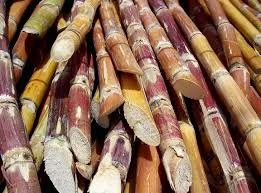
Sugar cane in the field
Cut cane, ready for the rolling mill


Most sugar in the U.S. is refined from sugar cane and sugar beets. Those, and many other plants, produce a sugar called sucrose. According to one source (realbakingwithrose.com), light brown sugar is usually 3.5% molasses, while dark brown has about 6.5% molasses added back to the refined white sugar product.

There are some obvious and some not-so-obvious differences in the various sugars. Most apparent are color and taste, both of which can show up in baked products. Molasses also brings some slight acidic features as well as more moisture. This can contribute to a bit more rise in a baked cookie, while light brown and white sugar will see successively more spread to the cookie, according to Serious Eats.

Finally, Professor's House suggests putting a half-pound of hardened brown sugar, covered with two wet (not dripping) paper towels, in a microwave-safe bowl sealed with plastic wrap. Nuke it for a couple minutes or so, then use a fork to stir and separate the sugar (CAUTION: sugar can stay very hot for an extended period). They suggest that the treated sugar not be stored but used immediately. Sweet!

;^)

9.9.11

Eureka!

Uh, hot cocoa, anyone?
It's a, uh...uh, a Cajun
recipe I found on the net— 
Chocolat au Lait Carbonisé
Blackened Cocoa!
Cooking, like other arts, occasionally depends on luck. Sometimes a screw-up will turn out to be an improvement, like my discovery that more butter and less milk makes mashed potatoes even better. Recently, trying to approximate the recipe at a local restaurant, I ended up with a meat loaf that turned out way too highly spiced. So I broke it into chunks and used it to make a spaghetti meat sauce—where it was just perfect. For that matter, it was much easier than making meat balls, and I may just use that method again.

There are two basic rules to dealing with cooking mistakes when presenting food to family, guests or customers:

1. Take full credit whenever anything turns out good, even if you screwed up. You simply say, "Thank-you. I had a feeling that it would be good this way."

2. When things turn out bad, blame the recipe. For instance, you can say "That is pretty bad, isn't it? I got this recipe variation on line; it was supposed to add a flavor layer, but not like this. Let's chalk it up to scientific research; that's one formula we know doesn't work. More wine?"

Trust me, all professional chefs know these two rules and follow
them assiduously. Chefs do not make cooking errors—it's just a
given. Cooking is a tough job, cooking well is even tougher. You need to give yourself a break whenever the opportunity comes up. Besides, it's an art, and art has always depended on luck. I don't reckon that prehistoric cave painter, when he was mixing pigments, was thinking, "I'll bet this hand print will still look good 10,000 years from now."

So, when it comes out great, you're an artist; when it fails miserably, you're a scientist. It will give your guests confidence and allow you to learn from your mistakes in peace.
This is my invariable advice to people: Learn how to cook — try new recipes, learn from your mistakes, be fearless, and above all have fun! Julia Child, My Life in France
Creativity is allowing yourself to make mistakes. Art is knowing which ones to keep. Scott Adams, The Dilbert Principle

;^)

2.6.11

Bowl me over

So, the other day I was sitting outside my rig, staring at the mountains and I’d let my mind off its leash. The old gray mass was wandering around, listening to the wind, looking at cloud shapes, sniffing the fresh air—when all of a sudden it whirls around and rushes back to me with this question:

Why do we serve pancakes on a plate?

Then you spend the entire meal chasing down errant syrup with the pancake bits you’ve impaled on your fork. Even expending all that effort, there’re still puddles of pancake syrup scattered about the plate when all the pancakes are gone.

Now I’m sure you, like I, learned in high school physics that pancakes and waffles posses the requisite properties allowing them to soak up all but the most over-thickened, bland-tasting, maple syrup substitutes. And I’m sure you, like I, have carried out the experiments proving these properties, taking note of how the bottom-most pancake absorbs the sucrose or fructose suspensions (i.e., syrup) with which it may come in contact.

How best, I wondered, to take advantage of these properties?

Eureka! I thought, serve pancakes in a bowl!

Concentrate the syrup to the center. Then, when you cut down through a stack and lift a section past your lips, you’ll be transferring saturation-point layers fully laden with maximum syrupy succulence.

I tried this out, using fried shredded wheat (Yes, Fried Shredded Wheat.) as my test medium. Works perfectly.

;^)

10.4.11

A Potato Primer

Photo credit**

So, you’re standing in the produce section of a typical American supermarket because your shopping list has “potatoes” on it. What do you need to know? Here are the basics.

There are four common types of potatoes found in many U.S. grocery stores. Each one has distinctive characteristics that suit
particular uses, mostly based on starch content.

1. Russet (sometimes called “Idaho” or “Baking” and several regional names, e.g., "Burbank") Probably the most common potato found in American markets. They have a sturdy brown to dark-brown, finely “netted” skin and tend to be an oblong, irregular shape with deep eye pits. They are likely to be the largest potatoes on display, but are sold in all sizes.
Clockwise, from upper left:
Russet, Red, Yellow and Purple
(Credit Colorado Potato Administrative Committee)

2. Red (sometimes called “Bliss”) Likely the second most common potato in your local produce section. Reds have a more tender skin than russets, somewhat glossy light red to brownish-red in color, rounder and with fewer eyes.

3. White Tend to be regional. A round version with tan to brown, sometimes speckled skin is grown in the northeastern U.S. An oblong type with light tan to brown skin is grown in California. Whites have very few discernible eyes. Market distribution is concentrated nearest where they are cultivated and diminishes with distance.

Photo credit**
4. Yellow (Also called “Gold”) These have a national distribution, but production levels sometimes limit supply. They are mostly round and have a thin, tender, yellow-tan to light brown skin with few eyes.

Other potato terms “New potatoes” are any early harvested potato, usually small in size and with a thinner skin; the most common variety marketed is new red potatoes. “Fingerling,” “Purple” and “Blue” potatoes are heritage varieties and are described by their names; the latter two also have like-colored flesh, though the basic potato taste is not affected (they can add some interest to a potato salad). “Sweet potatoes” aren't potatoes—nor are they yams.

Best uses for common potato varieties are indicated by the number
of dots; starch content is for comparison.


Some notable attributes of common potato varieties,
with starch content for comparison.
The accompanying charts can be a guide when it comes to using different varieties of potatoes, but don’t get hung up on them. In many instances the differences are minor and other qualities may counterbalance primary uses. In even a mild pinch, most potato varieties can substitute for one another. And if you don’t like the way it turns out, just call it “science” and try something different next time.

;^)

20.2.11

Some like it hot

So the other morning, being a mite chilly here in Tucson, I decided to make some hot chocolate. Not hot cocoa, mind you; there’s a difference.

Hot chocolate is what you make from a powdered mix of chocolate, sugar and multitudinous other ingredients, like Nesquik or

HOLY GUACAMOLE!
STOP THE PRESSES!

I just discovered that the Hershey company has discontinued Hershey’s Chocolate Milk Mix! This is beyond incredible! It's right up there with New Coke.

Someone there in Hershey, Pennsylvania has been standing way too close to the chocolate-powdering machines without respiratory protection. What, for pity's sake, is going on?! Is nothing sacred?

This is just too sad to continue to write about. I’m going to go to bed and pull the covers up over my head.

No wonder I haven't been able to find it for months now. I thought I was just hitting the wrong grocery stores. I just don’t believe….

To protest this travesty, click here to go to Facebook.


:,^ (

10.2.11

Horchata (an essay)

Like white on rice (Posted on Uncle Genie 11/22/2010)

There’s a peculiarly refreshing drink that becomes more commonly available the closer one comes to the Mexican border. It’s called horchata. Recipes for horchata include a variety of ground grains or nuts, but the version most commonly found along our southern border is made with ground rice.

I was introduced to horchata at a farewell luncheon held at a Mexican restaurant in Denver in 1995. I was leaving my job there and, at the lunch, one of my colleagues pointed it out on the menu and recommended I try it. I was hooked from the first taste.

Often called agua de horchata, it’s lighter than the so-called rice milks sold in grocery stores and actually has a more pronounced rice flavor. Its origins go back to Spain; there are even indications of Moorish influence.

There are numerous formulas on the net, but the only really tricky steps are grinding the rice and then straining the ground rice from the final beverage. After that process, generally it’s sweetened and usually flavored with cinnamon.

Of course, the simplest thing is to buy horchata already prepared. Some Mexican restaurants serve it and bottled varieties can be found in some groceries. My favorite brand is Kern, which is carried by Albertson’s here in Tucson.

Then all you need is a tall glass filled with ice and you’ve got a real thirst-quencher. In fact, there’s some horchata in my refrigerator right now—and I think I can hear it calling my name.

 ;^)