Enter at your own risk.
Showing posts with label potato. Show all posts

3.3.17

Hearty One-Skillet Meal

This dish has become a favorite, recently. It's a variation of a recipe from the Food Wishes channel on YouTube. There, Chef John presents it as an oven-roasted, open skillet that's started on the stove top. I discovered that I liked it better when I finished it, covered, and all on the stove top, no oven. It depends on how you like it. In the oven, it's finished crispy and caramelized, my version is moist and tender, with some caramelization on the meat. And it's also a bit easier.


To keep it simple, go ahead and watch the Food Wishes recipe linked above, it's only seven-and-a-half minutes, as most of Chef John's presentations are brief and practical. Then I'll list what I do that's different.
1. I use a 12-inch Cook's Standard stainless steel fry pan with dome lid (available on Amazon). It could be prepared in a cast iron or non-stick skillet, but it won't develop a flavorful fond.
2. On MEDIUM, start with hot oil or fat (chicken, bacon, lard, whatever) in the pan. Add the chicken thighs skin side UP in the center of the pan, then add any uncooked (fresh, not smoked) sausage¹ around the thighs.
3. Let that meat brown, uncovered, on one side while cutting up the peppers, onions and potatoes².
4. Turn all the browning meat over, thighs skin DOWN. Add any cooked (smoked) sausage then distribute the veggies, keeping the meat on the bottom of the pan to maximize browning.
5. I season liberally with Lawry's, black pepper, granulated garlic, marjoram, sage, summer savory, parsley and a little rosemary and basil. A bay leaf is optional, but it's not a flavor I like. And a little cayenne, if I'm using sweet (non-spicy) peppers.
6. Brown 5 minutes on MEDIUM.
7. COVER, turn to LOW for 40 minutes.
8. Serve    
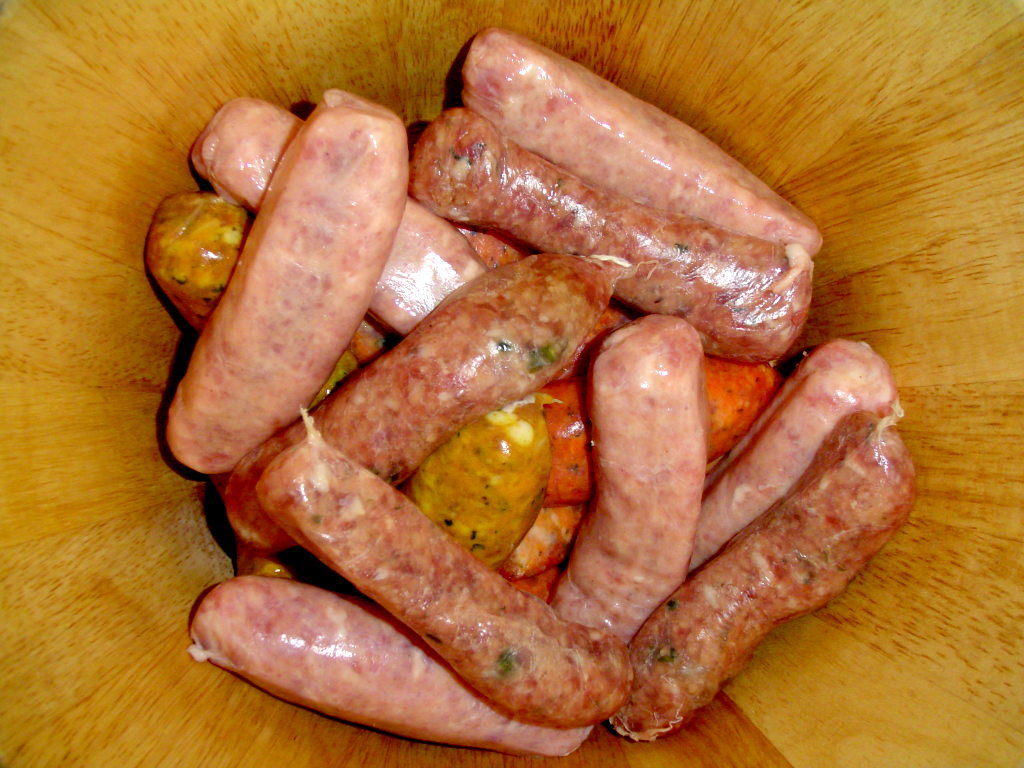
                
¹ I've used fresh and smoked kielbasa, bratwurst, hot links, andouille, both sweet and hot Italian sausages and cut-up country-style ribs, usually in combinations of two types. The rib meat didn't bring enough flavor whereas the chicken seems to absorb it. The sausage is easier to manage if I wait to cut it up until after cooking.
² I prefer the poblano (aka, ancho) peppers from my small hydroponic garden, but I've also used red bell peppers and canned diced green chiles. I've discovered that I can never have too much onion and it's nearly the same with potatoes. But maybe that's just me.

;^)

10.4.11

A Potato Primer

Photo credit**

So, you’re standing in the produce section of a typical American supermarket because your shopping list has “potatoes” on it. What do you need to know? Here are the basics.

There are four common types of potatoes found in many U.S. grocery stores. Each one has distinctive characteristics that suit
particular uses, mostly based on starch content.

1. Russet (sometimes called “Idaho” or “Baking” and several regional names, e.g., "Burbank") Probably the most common potato found in American markets. They have a sturdy brown to dark-brown, finely “netted” skin and tend to be an oblong, irregular shape with deep eye pits. They are likely to be the largest potatoes on display, but are sold in all sizes.
Clockwise, from upper left:
Russet, Red, Yellow and Purple
(Credit Colorado Potato Administrative Committee)

2. Red (sometimes called “Bliss”) Likely the second most common potato in your local produce section. Reds have a more tender skin than russets, somewhat glossy light red to brownish-red in color, rounder and with fewer eyes.

3. White Tend to be regional. A round version with tan to brown, sometimes speckled skin is grown in the northeastern U.S. An oblong type with light tan to brown skin is grown in California. Whites have very few discernible eyes. Market distribution is concentrated nearest where they are cultivated and diminishes with distance.

Photo credit**
4. Yellow (Also called “Gold”) These have a national distribution, but production levels sometimes limit supply. They are mostly round and have a thin, tender, yellow-tan to light brown skin with few eyes.

Other potato terms “New potatoes” are any early harvested potato, usually small in size and with a thinner skin; the most common variety marketed is new red potatoes. “Fingerling,” “Purple” and “Blue” potatoes are heritage varieties and are described by their names; the latter two also have like-colored flesh, though the basic potato taste is not affected (they can add some interest to a potato salad). “Sweet potatoes” aren't potatoes—nor are they yams.

Best uses for common potato varieties are indicated by the number
of dots; starch content is for comparison.


Some notable attributes of common potato varieties,
with starch content for comparison.
The accompanying charts can be a guide when it comes to using different varieties of potatoes, but don’t get hung up on them. In many instances the differences are minor and other qualities may counterbalance primary uses. In even a mild pinch, most potato varieties can substitute for one another. And if you don’t like the way it turns out, just call it “science” and try something different next time.

;^)